
HELP STARTS
WITH A CONVERSATION




Every Visit Is an Opportunity to Help
45%
of people who die by suicide are seen by a primary care provider within one month of their death.
77%
are seen by a provider within the year before their death — more than are seen by mental health specialists.
25%
fewer suicide attempts within 90 days when suicide care is built into ordinary primary care visits.
Why this matters in your practice
Suicide is common, rising, and not limited to the patients you might expect. There were 49,316 suicide deaths in the U.S. in 2023 — roughly one every 11 minutes. It is the second leading cause of death for people aged 15–34 and a leading cause across midlife. Men die by suicide at nearly four times the rate of women, with the highest rates among older and middle-aged men. Whatever your specialty, these patients are already on your schedule.
Your role
As a healthcare provider, you are often the first — and sometimes only — professional a patient in distress will talk to. The 988 Suicide and Crisis Lifeline is a free, confidential, 24/7 resource you can recommend to patients, caregivers, and families across every age and specialty with full confidence.
Brief clinical action works
Embedding routine suicide-care steps into ordinary visits reduced suicide attempts by 25% over the following 90 days in a study of more than 330,000 patients. Handing a patient a 988 card — or simply telling them 988 exists — is one of those steps.
Georgia performance
Georgia's 988 Lifeline is performing at a high level. Calls are answered in roughly 9–12 seconds on average as of early 2026, well inside the 30-second goal, following a temporary slowdown during the March 2025 platform migration. Fewer than 2% of contacts result in an active rescue — counselors prioritize de-escalation and support, not first responders. 988 is available 24/7 by call, text, or chat, free and confidential, in English, Spanish, ASL, and 240+ additional languages. Georgia publishes its performance data publicly at 988ga.org/data.
What to do
Make 988 visible in intake paperwork, after-visit summaries, discharge instructions, and portal messaging. Recommend it confidently alongside your clinical assessment. Use plain language: "You can call or text 988 anytime — it's free, confidential, and available 24/7. You don't have to be in a crisis to reach out.
A Quick Brief for Your Practice
Myths vs. facts, Georgia performance data, what to say to patients, and the evidence behind it — in a single printable page for your team.
Myths vs. Facts
-
FACT: Georgia answers calls in roughly 9–12 seconds on average as of early 2026, well inside the 30-second goal.
-
FACT: 988 does not contact 911, police, or fire unless there is imminent risk to life. Fewer than 2% of contacts result in an active rescue.
-
FACT: 988 serves anyone in a mental health, substance use, or emotional crisis, including patients calling on behalf of someone they're worried about.
Stock Your Waiting and Exam Rooms — Free
Order free printed suicide-prevention guides for your practice, courtesy of Georgia's Department of Behavioral Health and Developmental Disabilities, developed in partnership with the Georgia Chapter of the American Academy of Pediatrics and Children's Healthcare of Atlanta.
Materials ship to your practice within 10 days.
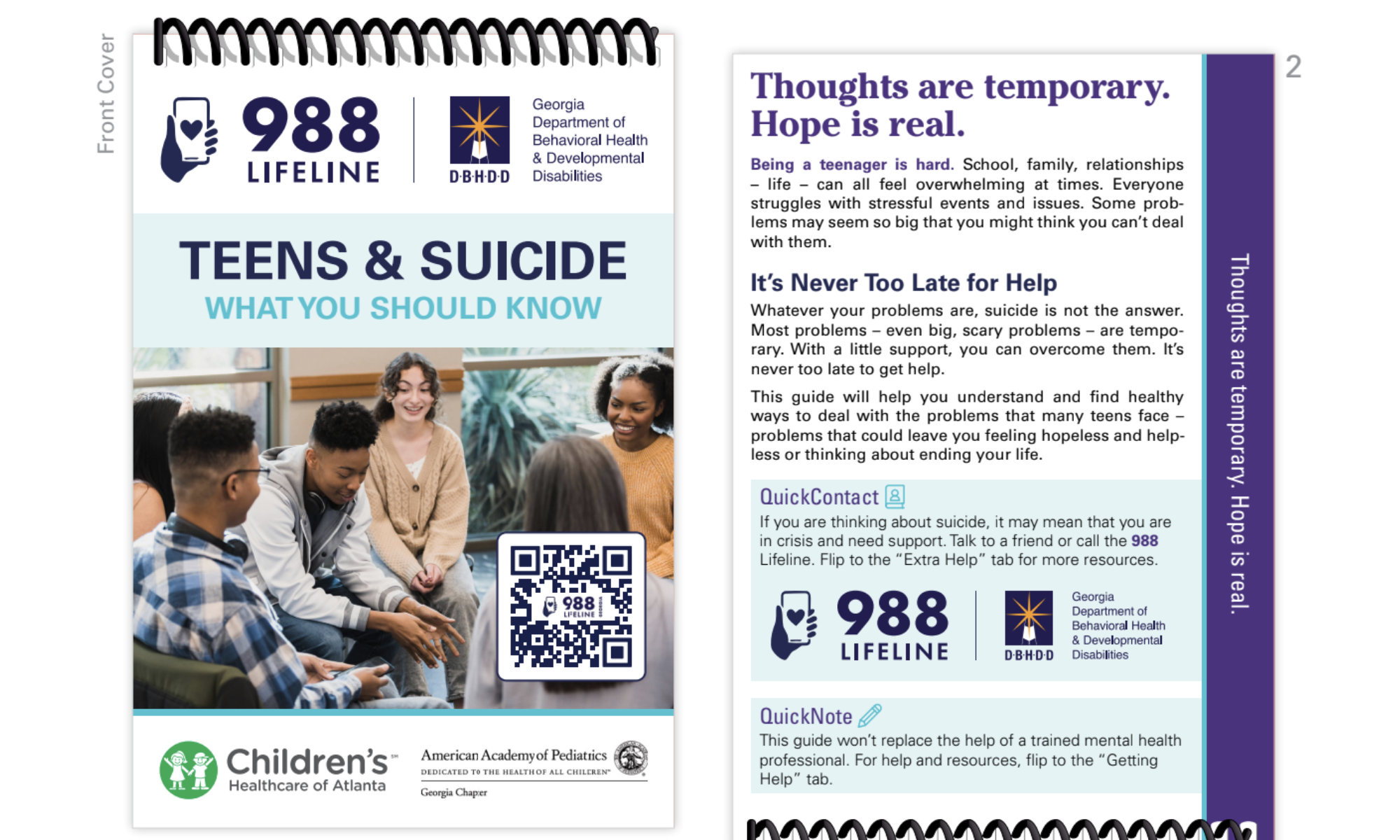
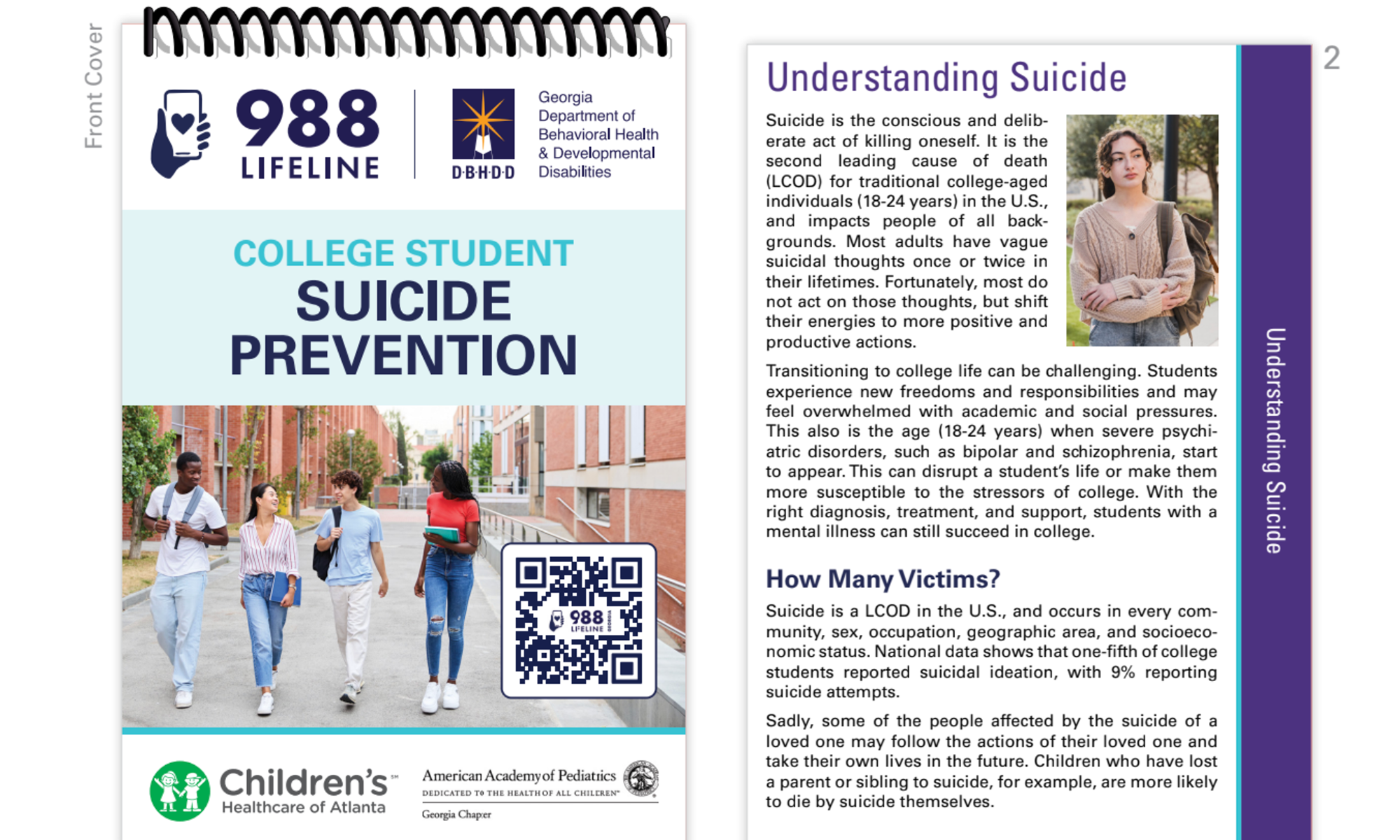
About the materials:
These 3.75 × 5.5 guides are compact enough to fit in a pocket or backpack, making them easily accessible for teens and college students when they're feeling overwhelmed or hopeless.
Teen guide — a relatable checklist of common teen challenges, plus practical advice for handling difficult situations and finding help for themselves or a friend.
College guide — for students navigating new responsibilities and freedoms that can lead to depression, anxiety, or suicidal thoughts. Covers recognizing when someone is struggling, how to offer initial support, protective factors, warning signs, and intervention strategies.
Caring for Children, Teens and Young Adults
Half of all lifetime mental illness begins by age 14 and 75% by age 24 — making pediatric, adolescent, campus, and family-medicine encounters critical windows. Nearly 1 in 5 children has a mental, emotional, or behavioral disorder, yet only about 20% receive care from a mental-health specialist. Parents may have worries about a child they haven't shared with you; anyone can call or text 988 on behalf of someone they're concerned about.
For You
Clinicians carry heavy emotional loads and are not immune to burnout or crisis. Your wellbeing matters — to your patients and to your community. If you are struggling, you can call or text 988, too. It's free and confidential.

Get Equipped
To Help
You play a critical role in your patients' mental health. Our training resources help you identify warning signs, navigate difficult conversations, and understand exactly how 988 works — so you can be a bridge to lifesaving professional care.
Proudly in Partnership with